Introduction
Ubon Ratchathani occupies a unique position in Thai Buddhism that its relative obscurity on the tourist trail only makes more valuable to the traveler who finds it. This provincial capital at Thailand's far eastern edge, where the Mun River meets the Mekong and the borders of Laos and Cambodia converge, has accumulated a constellation of remarkable temples over many centuries — each carrying a different architectural lineage, a different story, and a different quality of spiritual atmosphere. There is Wat Thung Si Mueang with its impossibly beautiful library pavilion afloat on a lotus pond; Wat Phra That Nong Bua, whose gleaming white stupa rises like a transplanted piece of Bodh Gaya; and Wat Nong Pa Phong, the forest monastery of Ajahn Chah, which draws Buddhist practitioners from Europe, America, and Australia on a quiet but steady pilgrimage. These are not museums dressed in robes — they are living monasteries, centers of practice and learning, where the encounter between resident monks and respectful visitors carries a depth unavailable at more touristed sites.
Overview
The temple landscape of Ubon Ratchathani reflects the city's complex history as a crossroads between Lao, Khmer, and central Thai cultural traditions. Unlike the temples of Chiang Mai, which sit comfortably within a single Lanna architectural tradition, or the grand Bangkok wats that embody Rattanakosin-period power, Ubon's religious sites speak multiple architectural languages simultaneously — sometimes within a single compound.
Wat Thung Si Mueang stands near the city center and is arguably the most photographically arresting temple in eastern Thailand. Its Ho Trai — the library building housing sacred manuscripts — sits at the center of an ornamental pond on a stilted platform, a design intended to protect manuscripts from insects by surrounding them with water. The building itself is a masterpiece of the Rattanakosin period, its exterior covered in intricate stucco relief work depicting scenes from Buddhist cosmology. The wat's ordination hall contains murals painted by monks in the early nineteenth century that record scenes of daily life in old Ubon alongside the expected religious imagery — making them an invaluable historical document as much as a religious artwork.
Wat Jaeng is Ubon's oldest functioning temple, with origins dating to the earliest Lao settler communities who established the city. Its bots and viharns have been rebuilt multiple times, but ancient stucco reliefs survive on some structures, and the compound retains an undisturbed quality unusual for a city-center location. Local monks use it primarily as a working monastery rather than a tourist site.
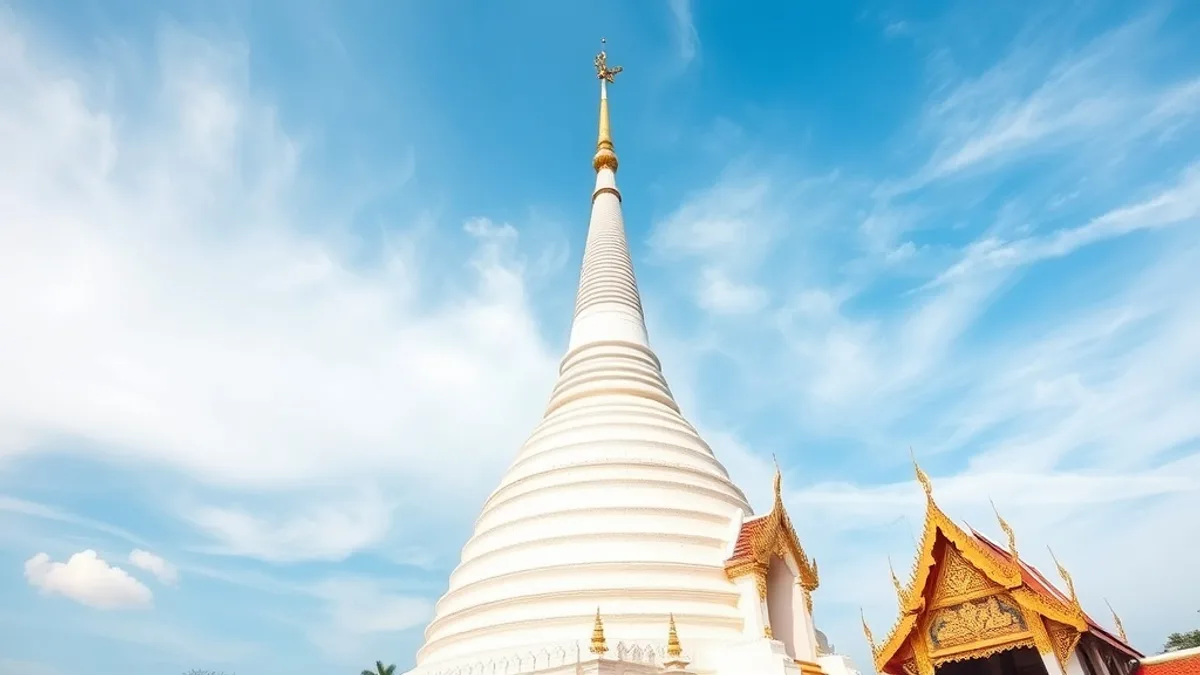
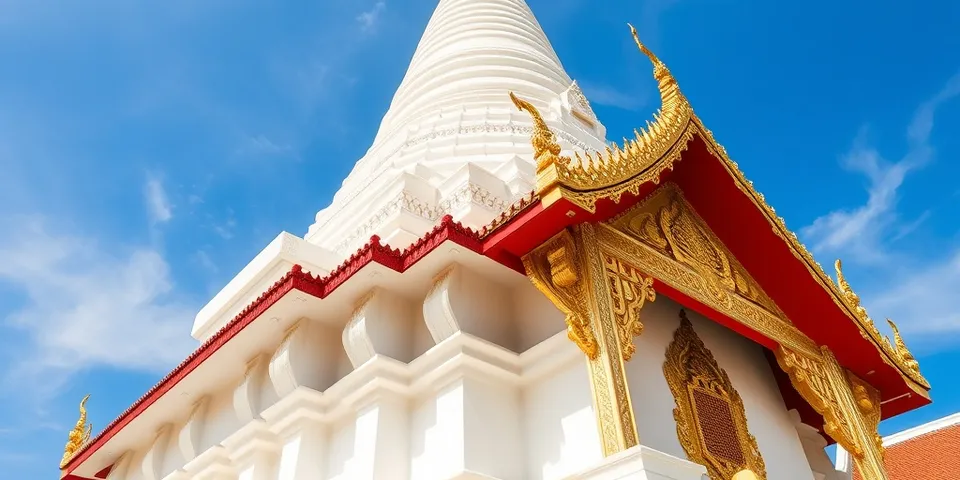
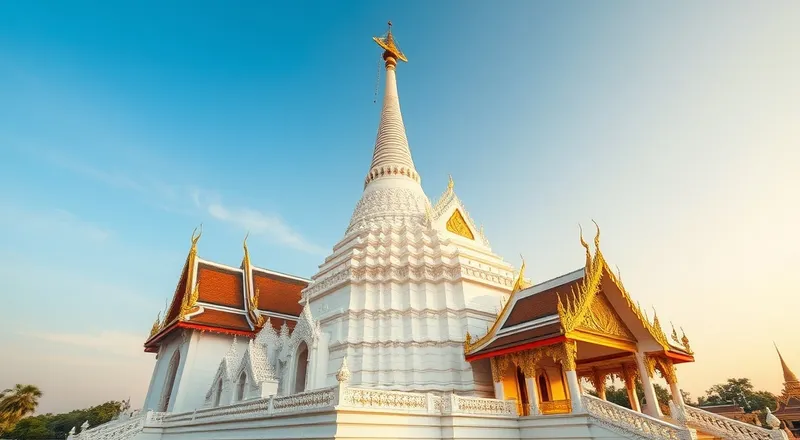
Wat Phra That Nong Bua, located just north of the city center, represents one of the most extraordinary acts of architectural devotion in all of Thailand. Its central stupa — a massive white chedi rising 55 meters — was constructed in deliberate homage to the Mahabodhi Temple at Bodh Gaya in India, the site of the Buddha's enlightenment. The likeness is striking: the same tapering tower, the same ornate niches containing standing Buddha images, the same sense of vertical aspiration. The temple was constructed in 1956 to celebrate the 2,500th anniversary of the Buddha's enlightenment, and the four corner towers surrounding the main chedi each contain detailed bas-relief carvings of scenes from the Jataka tales.
Wat Si Ubon Rattanaram, the province's most senior royal temple, houses a famous replica of the Emerald Buddha — the sacred image at the heart of Thai royal Buddhism enshrined at Wat Phra Kaew in Bangkok. The replica was presented to Ubon in recognition of the province's spiritual importance, and it occupies the same position of devotional centrality in local religious life that the original holds nationally.
Wat Nong Pa Phong, located some 12 kilometers from the city center in a forested setting, is in a category of its own. The forest monastery established by Ajahn Chah (1918–1992) — one of the most influential Theravada meditation masters of the twentieth century — became a center for the training of foreign Buddhist monastics from the 1970s onward. Ajahn Chah's Western students founded branch monasteries across Europe, North America, and Australia; Amaravati in England and Abhayagiri in California are among the most prominent. The original monastery at Nong Pa Phong continues to function as a training center, and the stupa enshrining Ajahn Chah's relics draws pilgrims from across the Buddhist world. Visitors are welcome but should observe the strict silence and formal conduct codes of a working forest monastery.
Highlights
- Wat Thung Si Mueang's iconic Ho Trai manuscript library floating on a lotus pond
- Nineteenth-century murals at Wat Thung Si Mueang depicting daily life in historic Ubon
- Wat Phra That Nong Bua's 55-meter white stupa modeled on India's Mahabodhi Temple
- Jataka tale bas-relief carvings on the corner towers of Wat Phra That Nong Bua
- Ubon Ratchathani National Museum — excellent collection of regional art and history
- Wat Nong Pa Phong forest monastery of the revered Ajahn Chah — a global pilgrimage site
- The Emerald Buddha replica enshrined at Wat Si Ubon Rattanaram
- Ancient stucco reliefs surviving at Wat Jaeng, Ubon's oldest active temple
- The distinctive blend of Lao, Khmer, and Thai architectural traditions across the temple circuit
The temple circuit is rewarding year-round, but November through February offers the most comfortable temperatures for outdoor exploration (25–30°C). The Candle Festival in July brings all Ubon's temples to their most ceremonially intense. Early morning visits — before 8:30 AM — offer the temples at their quietest and most contemplative. Wat Nong Pa Phong maintains silence protocols throughout the day; its special visiting periods for laypeople are announced on the monastery's website and at the entrance gate.
Practical Information
Cost Level
Most Ubon temples have no entrance fee or request a small voluntary donation of 20–50 THB. Ubon Ratchathani National Museum charges 100 THB for foreign visitors and 20 THB for Thais. Tuk-tuk between city-center temples: 40–70 THB per hop. A half-day tuk-tuk charter covering four to five temples, including Wat Nong Pa Phong, runs 400–600 THB negotiated. Motorbike rental (for independent exploration): 200–250 THB per day from guesthouses near the bus terminal.
Tips
Temple etiquette in Ubon is observed more strictly than at many tourist-facing wats — bring a sarong or long trousers and a modest top, and remove shoes at every entrance. At Wat Nong Pa Phong, silence is an explicit expectation rather than a suggestion: turn phones to silent and maintain quiet throughout the compound. The National Museum is a genuine asset — its collection of Ubon-area artifacts, including prehistoric bronze drums and Khmer sculptural fragments, provides context for everything else you see. Photography of monks requires their consent and should never interrupt a practice session or ceremony.
Our creators on the ground in Ubon-ratchathani share their best recommendations in their videos.

Places in this Guide
Discover the attractions and locations featured in this travel guide.
Explore Ubon Ratchathani
Ubon Ratchathani
อุบลราชธานีUbon Ratchathani is a culturally rich province in Thailand's far northeast, bordering Laos along the Mekong River. The c...All creators from Ubon Ratchathani →Location & Orientation


Frequently Asked Questions
Can I visit Wat Nong Pa Phong and how should I behave there?
Wat Nong Pa Phong welcomes respectful lay visitors, but it functions as an active forest monastery with strict behavioral expectations. Silence should be maintained throughout the compound. Wear modest, covering clothing — long trousers or skirts, shoulders covered. Photography of the stupa and grounds is generally acceptable; photography of monks or their activities should never occur without explicit permission and should never be done during meditation or chanting. The visiting area is separate from the monks' quarters. Check the monastery's website or the entrance notice board for any temporary restrictions or special events that may affect visiting access on a given day.
What makes Wat Phra That Nong Bua different from other Thai chedis?
Wat Phra That Nong Bua's stupa is architecturally unique in Thailand because it was built as a deliberate replica of the Mahabodhi Temple in Bodh Gaya, India — the site of the Buddha's enlightenment under the Bodhi tree. Most Thai chedis follow indigenous forms: the tapering Sukhothai bell-shape, the Lanna cylindrical tower, or the Rattanakosin spire. The Mahabodhi form, with its tall pyramidal tower flanked by smaller corner towers and covered in ornate niches containing standing Buddha images, is rare in Thailand. The 1956 construction date — chosen to mark 2,500 years since the Buddha's enlightenment — gives the site a particular commemorative significance that locals and pilgrims feel strongly.
How long does a full temple circuit of Ubon Ratchathani take?
A comfortable visit to the four main city-center temples — Wat Thung Si Mueang, Wat Jaeng, Wat Phra That Nong Bua, and Wat Si Ubon Rattanaram — takes a half day with transport between them. Adding the National Museum extends this to a full day. Wat Nong Pa Phong is best treated as a separate half-day excursion, allowing enough time to reach it by motorbike or tuk-tuk, spend an hour in the grounds, and return. A two-day temple focus in Ubon, combining city wats and Nong Pa Phong, would feel unhurried and allow time for the museum and the Mun River promenade.
Is Ubon Ratchathani easy to reach from Bangkok?
Ubon Ratchathani has good transport connections despite its distance. Overnight trains from Hua Lamphong station in Bangkok (departure around 9 PM, arrival around 7 AM) are comfortable and inexpensive — second-class air-conditioned sleeper berths cost 580–800 THB. Overnight VIP buses from Mo Chit terminal run 450–600 THB and take eight to nine hours. Domestic flights from Don Mueang or Suvarnabhumi on Lion Air, Nok Air, or Bangkok Airways take 75 minutes and cost 700–2,500 THB depending on timing and advance booking. Ubon's airport is 3 kilometers from the city center; the train station is central.
Are there any female monks or nuns at Ubon's forest monasteries?
The Thai forest tradition includes a significant tradition of maechis — women who take the eight or ten precepts and live in monastic communities, though their status within Theravada orthodoxy differs from that of fully ordained bhikkhunis. Wat Pah Nanachat, a branch monastery of Wat Nong Pa Phong located nearby and oriented toward international practitioners, also has associated women's practice facilities. The question of female ordination is a live and evolving discussion within Thai Buddhism; travelers interested in this dimension of the tradition will find Ubon's monasteries thoughtful and engaged places to explore it, particularly through public Dhamma talks given on Buddhist holy days.