
Introduction
The Khmer Empire at its height in the 11th to 13th centuries was the most sophisticated civilization in Southeast Asia — and its western frontier ran directly through what is now northeast Thailand. Across the Isaan plateau, the empire left behind a network of temples, rest houses, and royal roads that connected the Cambodian capital of Angkor to the most distant reaches of Khmer authority. These temples were not provincial outposts — they were full expressions of Khmer cosmological architecture, built in the same sandstone and laterite as Angkor itself, carved by the same tradition of sculptural mastery, and oriented according to the same astronomical and religious principles. Today, dozens of these sanctuaries survive across Isaan's provinces, from the hilltop magnificence of Phanom Rung to forgotten foundations buried in rice paddies. Together they constitute one of the great archaeological temple trails of Southeast Asia — one that most visitors to the region never discover.
Overview
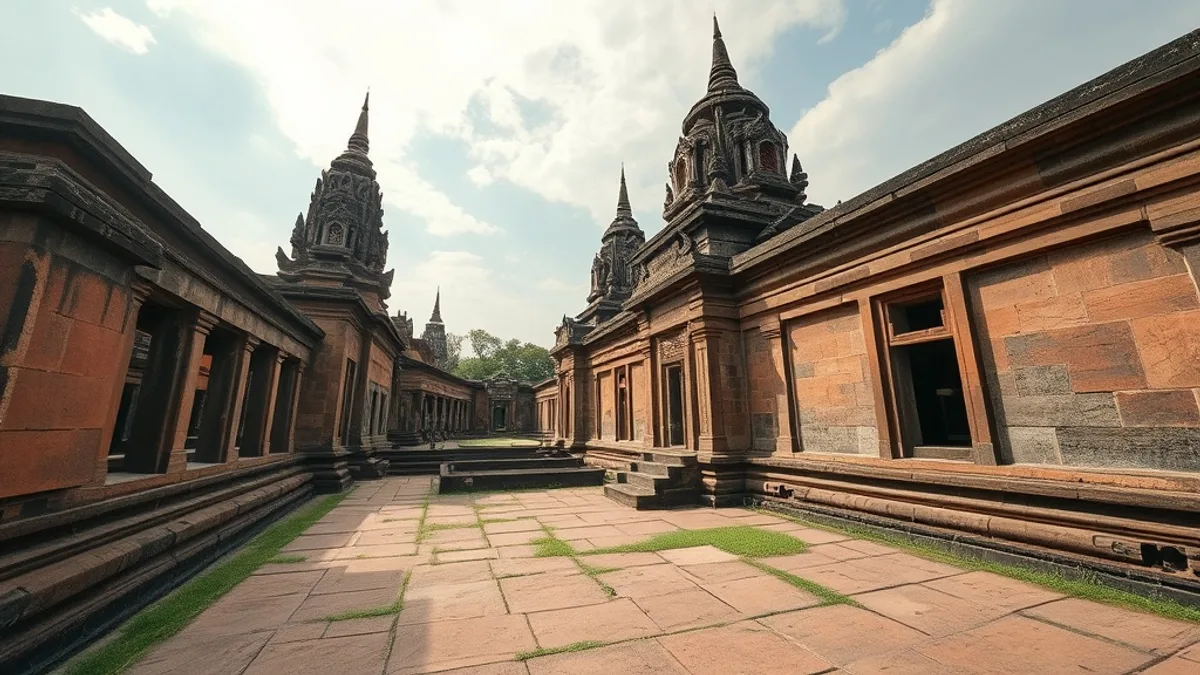
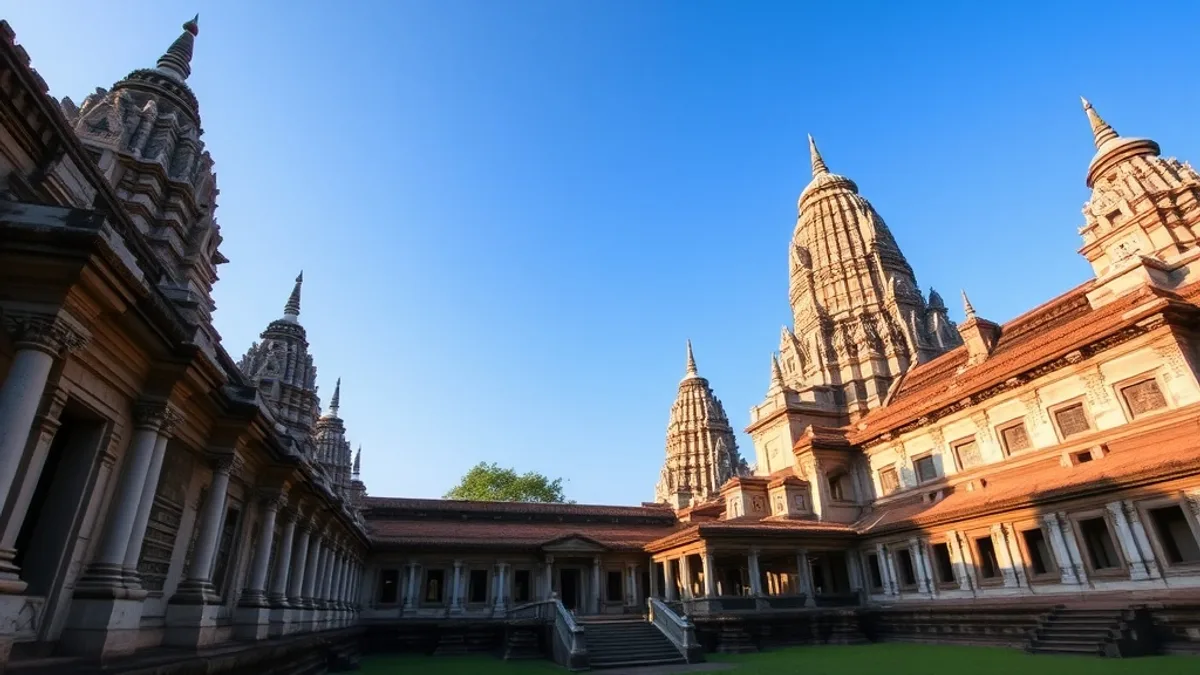
The Isaan Khmer temple trail spans four primary provinces — Buriram, Surin, Si Saket, and Nakhon Ratchasima — and contains over fifty recognized Khmer sites in various states of preservation. The most spectacular is Phanom Rung in Buriram, built on a volcanic summit and oriented with cosmological precision toward Angkor Wat far to the southeast. Its processional causeway, 160 meters long with sandstone pillars, leads to one of the finest Khmer sanctuary towers in existence. The April solar alignment, when the rising sun passes through all 15 doorways simultaneously, is a feat of astronomical engineering that demonstrates the sophistication of Khmer spatial planning.
Phimai Historical Park in Nakhon Ratchasima is the most accessible major Khmer site from Bangkok and served as a critically important Khmer religious and administrative center. Built primarily in the 11th century, it is connected to Angkor by an ancient royal road (the Angkor-Phimai road) that runs for 230 kilometers through the Khorat Plateau. Unlike Phanom Rung, Phimai is in the center of a modern town and can be explored in combination with the adjacent Phimai National Museum, which contains one of the finest collections of Khmer art outside the National Museum in Phnom Penh.
Prasat Sikhoraphum in Surin province is a strikingly beautiful 12th-century sanctuary set amid water-lily covered ponds that create reflections as atmospheric as Angkor Wat's famous moat. The five towers in cruciform arrangement are in excellent condition and the carved lintels include some of the most intricate mythological scenes in Isaan Khmer art. The site receives far fewer visitors than Phanom Rung or Phimai, making it one of the genuinely serene temple experiences available in the region.
Prasat Hin Wat Sa Kamphaeng Yai in Si Saket province is another overlooked masterpiece — a large rectangular temple complex with remarkably well-preserved gallery walls and a main tower whose lintel carvings rival those of Phanom Rung in quality. The Si Saket region contains multiple additional Khmer sites clustered close enough together to form an excellent half-day circuit by motorbike.
The border temple of Prasat Preah Vihear presents the most dramatic setting of any Khmer temple — perched on a cliff edge of the Dangrek Mountains on the Thai-Cambodian border, with stunning views across the Cambodian plains thousands of feet below. The temple itself is technically under Cambodian sovereignty (confirmed by the International Court of Justice in 1962) but is accessed from the Thai side via a national park in Si Saket province. Access arrangements change periodically with border relations — check current status before planning a visit.
For travelers familiar with Angkor Wat, the Isaan temples offer a fascinating comparative perspective. The same architectural vocabulary — gopura gateways, prasat towers, naga balustrades, concentric galleries — appears throughout, allowing visitors to trace the development of Khmer style across different periods and locations. The quieter Isaan sites also allow a more contemplative encounter with the architecture than the crowds at Angkor Wat permit.

Highlights
- Phanom Rung — hilltop Khmer masterpiece with April solar alignment through 15 doorways
- Phimai — 11th-century sanctuary at the end of the 230km ancient Khmer royal road
- Prasat Sikhoraphum water-lily ponds and five-tower cruciform in Surin
- Prasat Hin Wat Sa Kamphaeng Yai — Si Saket's overlooked lintel carving masterpiece
- Prasat Preah Vihear cliff-edge temple with views across Cambodia
- Khmer art iconography trail — tracing Vishnu, Shiva, and Buddhist motifs across provinces
- Phimai National Museum — finest Khmer art collection in northeast Thailand
- Prasat Mueang Tam's four baray ponds and Naga balustrades 8km from Phanom Rung
- Motorbike self-touring the temple trail across Buriram, Surin, and Si Saket
November to February provides ideal conditions — comfortable temperatures for outdoor exploration, dry roads for motorbike touring, and clear skies for photography. April brings the unmissable solar alignment event at Phanom Rung but is extremely hot. The wet season (June–October) makes some rural temple access roads difficult but gives the water-surrounded sites like Mueang Tam and Sikhoraphum an extraordinary atmospheric quality when the baray ponds are full and monsoon clouds build dramatically overhead.
Practical Information
Cost Level
Entry fees: Phanom Rung 100 THB, Phimai 100 THB, Prasat Sikhoraphum 100 THB, most smaller sites free. Phimai National Museum: 150 THB. Motorbike rental for self-touring: 200–250 THB/day. Budget accommodation in Nang Rong (Buriram), Surin city, or Si Saket city: 350–600 THB/night. Local buses between Isaan cities: 80–200 THB. A comprehensive multi-day Isaan temple trail budget, covering Buriram, Surin, and Si Saket provinces with accommodation and transport: 3,000–5,000 THB per person.
Tips
The Isaan Khmer temple circuit rewards a slow approach over 3–5 days rather than rushed day-tripping. Nang Rong is the ideal base for Buriram temples; Surin city for Surin and Si Saket temples. Hire a motorbike rather than relying on songthaews to reach smaller sites — the freedom to stop spontaneously at unmarked roadside ruins is essential. The Fine Arts Department website lists all recognized Khmer sites in Thailand with GPS coordinates — download the list before your trip. Early morning light (7–9am) is consistently best for photographing sandstone temples.
Our creators on the ground in Isan share their best recommendations in their videos.
Creators who cover this spot
Discover YouTube creators who feature this topic in their videos.

Adventures Joel
British adventure vlogger exploring Thailand by motorbike.

Discover Thailand
Christian
Discover Thailand – Deutscher Thailand Reise-Creator auf YouTube.

Ricky in Isaan
British expat documenting authentic daily life and culture in rural Isaan, Thailand.


Places in this Guide
Discover the attractions and locations featured in this travel guide.
Explore Isaan
Isaan
อีสานIsan is the rural Northeast of Thailand, known for authentic village culture, rice farming, strong family structures and...All creators from Isaan →Location & Orientation

Frequently Asked Questions
How does the Isaan Khmer temple trail compare to Angkor Wat?
Angkor Wat is incomparable in scale — as a 12th-century walled city it covers 400 square kilometers and includes dozens of major temple complexes. The Isaan temples are individual sanctuaries rather than city complexes. However, the quality of carving at the finest Isaan sites rivals Angkor directly — Phanom Rung's lintels and Phimai's decorative stonework are masterworks by any standard. The crucial difference is atmosphere: the Isaan temples are visited by a tiny fraction of Angkor's tourist volume, meaning you often have extraordinary Khmer architecture completely to yourself. For travelers who have already visited Angkor, the Isaan temples provide remarkable depth and context.
What is the best order for visiting the Isaan Khmer temples?
A logical route from Bangkok follows: Day 1 — Phimai (easiest access from Bangkok, full day including museum). Day 2 — overnight train or bus to Buriram, arrive in Nang Rong. Day 3 — Phanom Rung and Mueang Tam plus satellite sites. Day 4 — train to Surin, Prasat Sikhoraphum and other Surin temples. Day 5 — Si Saket for Prasat Sa Kamphaeng Yai and the border temple region. This 5-day route covers the major sites in a logical geographic progression and can be done entirely by public transport, though motorbike touring between temples within each province is highly recommended.
Can I visit Prasat Preah Vihear from the Thai side?
Prasat Preah Vihear is accessible from the Thai side via the Khao Phra Wihan National Park in Si Saket province, though access arrangements have historically been subject to diplomatic tensions between Thailand and Cambodia. The Thai access route provides a spectacular approach up the Dangrek escarpment and views from the Thai side of the cliff. Before planning a visit, check the current status with the TAT or the national park directly, as border access has been closed during periods of diplomatic strain. When open, the national park entry fee is 200 THB; a guide or driver is strongly recommended for the mountain access road.
Are there guided Khmer temple tours available in Isaan?
Organized day tours to Phanom Rung and Phimai depart from Nakhon Ratchasima (Korat) city and can be booked through guesthouses and tour operators there. These are practical for visitors without their own transport but cover only the headline sites and move at fixed paces. For the broader temple trail, most serious temple visitors self-tour by hiring a motorbike or renting a car. Local guides can sometimes be arranged at Phimai National Museum or through accommodation providers in Nang Rong for Buriram temples. The Fine Arts Department rangers at each site are knowledgeable about local history and usually speak some English.
What should I know about Khmer art to appreciate the temples better?
Understanding a few key iconographic elements transforms temple visits from looking at old stone to reading a complex religious text. The principal deities are Shiva (often depicted as a lingam phallic pillar, or in dancing Nataraja form), Vishnu (four-armed, holding conch, discus, lotus, and mace), and various manifestations of the goddess (Uma, Durga). The naga (multi-headed serpent) represents the bridge between human and divine worlds and appears on balustrades and lintels everywhere. The kala (demon face swallowing garlands) appears above doorways as a protective deity. Garudas (eagle-man creatures) support the architecture in carved form. Most temples are oriented east-west, toward Angkor and the rising sun.