Introduction
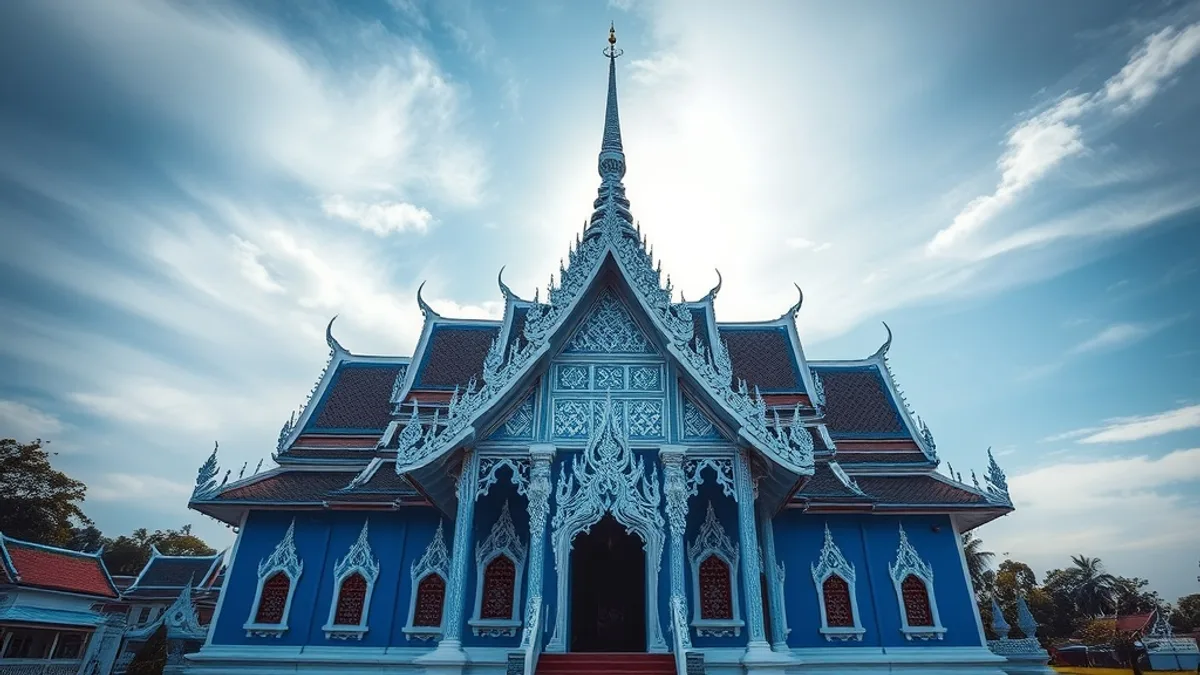
Chiang Rai has quietly become one of Southeast Asia's most compelling destinations for contemporary sacred art, and the movement extends far beyond the famous White Temple that draws tour buses by the hour. Wat Rong Suea Ten — the Blue Temple — stands as a vivid counterpoint: electric cobalt walls, intricate white serpent motifs, and a serene white Buddha seated at the heart of a structure completed only in 2016. Across town, the sprawling Baan Dam complex conceived by the late master Thawan Duchanee presents an entirely different vision — dark, provocative, utterly unmissable. Together with Wat Rong Khun, these three sites have transformed a provincial city near the Myanmar border into an open-air gallery where contemporary Thai artistic ambition intersects with living religious tradition. This guide covers all three in detail, explains the artistic philosophy behind each, and shows you how to fit them into a single rewarding day with time to spare for the surprises in between.
Overview
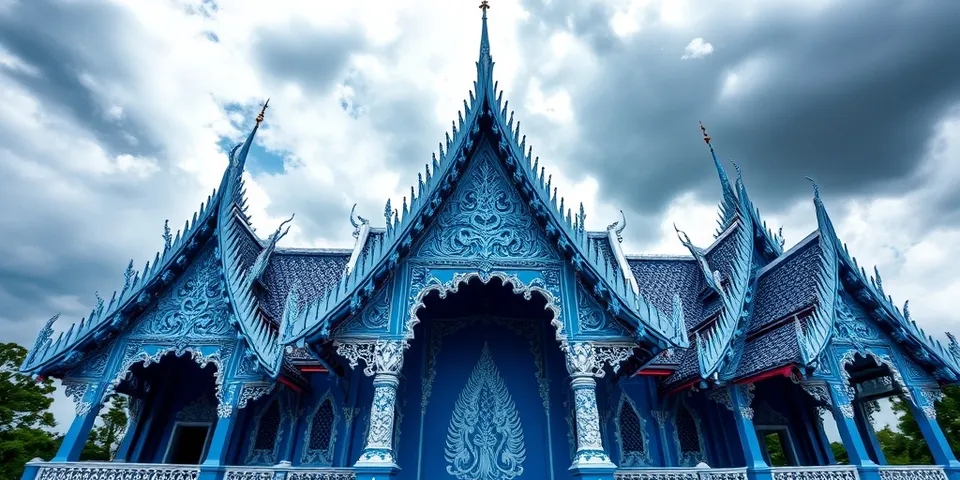
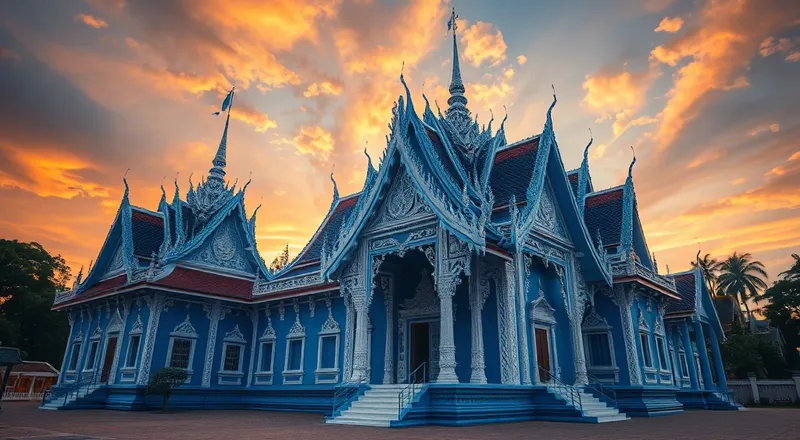
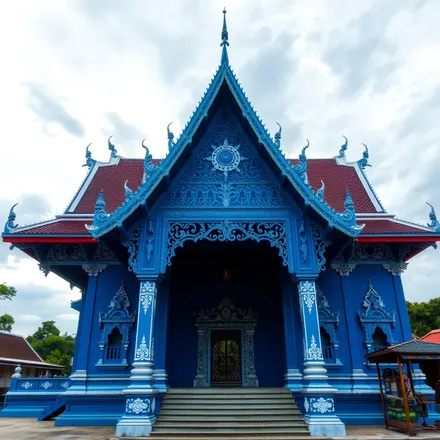
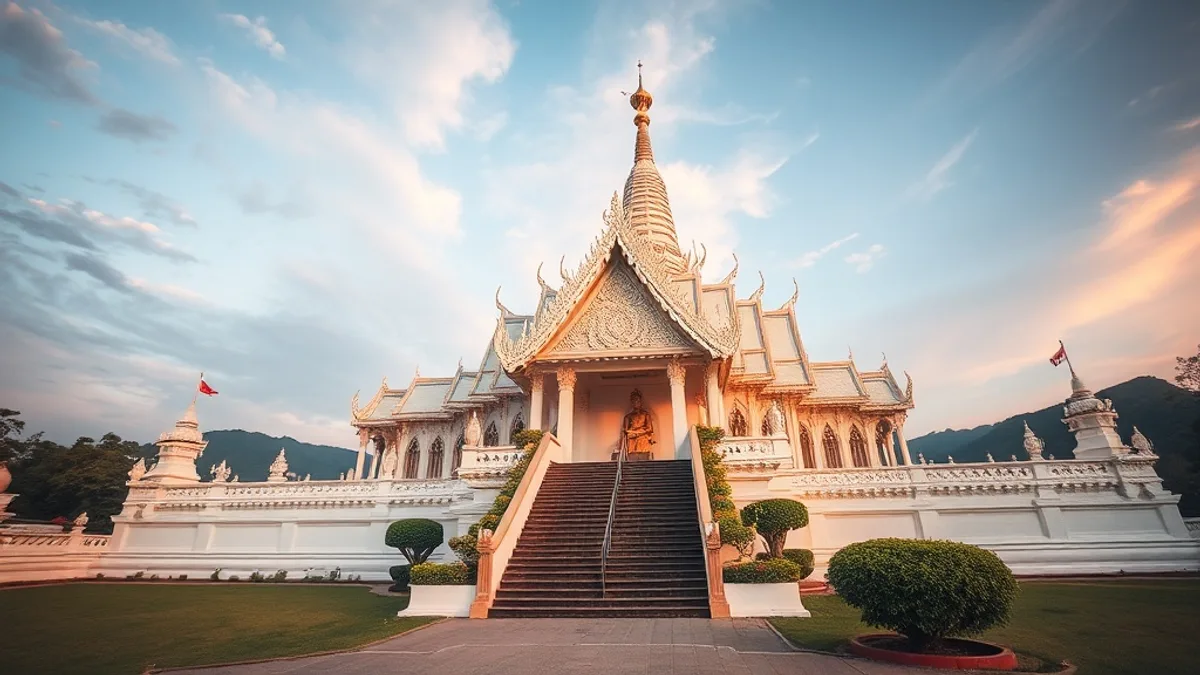
Wat Rong Suea Ten — whose name translates roughly as the Temple of the Dancing Tiger — occupies a bend in the Kok River on the eastern edge of Chiang Rai city. The site has religious significance stretching back centuries, and local legend holds that tigers once roamed this stretch of riverbank. The current structure, however, is entirely contemporary: construction began in 2005 under the direction of artist Putha Kabkaew, a former student of Chalermchai Kositpipat, and the main chapel was completed and consecrated in 2016. Kabkaew's vision for the Blue Temple was to represent the sky and the heavens — a realm of purity contrasted through colour rather than white reflective glass. The exterior is a deep, saturated blue adorned with white plaster serpent (naga) motifs of extraordinary precision, their scales and fangs rendered with almost obsessive detail. Gold leaf accents catch the light at different hours of the day, giving the temple a different character at sunrise, midday, and in the late afternoon when shadows deepen the blue to near-indigo.
Inside, the effect is even more dramatic. The entire interior is covered in deep blue murals depicting scenes from Buddhist cosmology — celestial beings, lotus flowers, and mandala patterns rendered in rich lapis, cobalt, and midnight tones. At the centre sits a large white Buddha image with an expression of serene compassion that seems to float against the deep colour behind it. Unlike the White Temple's pop-culture murals, the Blue Temple's interior maintains an almost orthodox grandeur, and the result is a space that feels genuinely sacred despite its recent construction. Entry is free and the temple is open daily, typically from around 7 AM to 8 PM. Early morning visits are particularly rewarding — the rising sun hits the blue exterior from the east and transforms the entire façade into something luminous.
Baan Dam, the Black House, lies about four kilometres north of the city centre and represents perhaps the most singular artistic vision in all of northern Thailand. The late Thawan Duchanee — one of Thailand's most celebrated and controversial artists, a National Artist who trained in Amsterdam and returned to create work deeply rooted in northern Lanna traditions — spent forty years assembling this complex of over forty buildings. Dark teakwood structures, blackened exteriors, crocodile skins stretched across tables, elk antlers mounted above doorframes, serpent skeletons coiled in vitrines, and bones of animals accumulated over decades: Baan Dam is a monument to mortality, to the dual nature of existence, and to the artist's intense engagement with themes that Buddhist cosmology traditionally consigns to shadow.
Thawan Duchanee died in 2014 and is buried on the grounds. The complex is now maintained as a museum and cultural foundation. Some rooms are open to walk through; others can be seen only through doorways and windows. The effect of wandering through the grounds — particularly on a quiet weekday morning when tour groups are absent — is genuinely unsettling in the best possible way. Admission costs around 80 THB for international visitors.
The three temples — White, Blue, and Black — form a loose but coherent artistic trilogy that rewards thoughtful comparison. Kositpipat's White Temple celebrates purity, aspiration, and the continuity of Buddhist tradition into the modern world. Kabkaew's Blue Temple honours celestial grandeur with a more orthodox reverence. Duchanee's Black House confronts impermanence and the necessary darkness that gives light its meaning. Together they reflect a broader movement of contemporary Thai artists engaging with sacred spaces not as passive inheritors but as active creators — a tradition rooted in the ancient patronage of Buddhist art but evolving in entirely new directions. Several younger artists in Chiang Rai are now working on smaller-scale projects inspired by this generation, and the city's art scene continues to grow with galleries, residencies, and public installations appearing regularly in the old city centre.
Highlights
- Photograph the electric deep-blue exterior of Wat Rong Suea Ten at sunrise when the façade glows against a warm sky
- Explore the intense lapis-blue interior murals and serene white Buddha of the Blue Temple
- Wander the forty-building complex of Baan Dam and encounter Thawan Duchanee's provocative vision of death and beauty
- Compare the artistic philosophies of three living master artists across three radically different sacred spaces
- Discover the intricate white naga serpent motifs that wrap the Blue Temple's exterior walls
- Visit the Blue Temple early morning for an uncrowded, meditative experience completely unlike the White Temple crowds
- Understand the Lanna artistic tradition that underpins all three sites through their use of local materials and symbolism
- Photograph Baan Dam's dark wooden structures against the surrounding garden — one of the most distinctive compositions in Thailand
- Combine all three temples in a single half-day circuit starting at 7 AM for the best light and smallest crowds
The Blue Temple and Baan Dam can be visited year-round, but the cool-season months from November to February offer the most comfortable conditions. Chiang Rai's mornings can be cool — even cold in December and January — making early starts pleasant rather than punishing. March to May brings heat and agricultural burning haze that can obscure views and irritate the lungs. The rainy season from June to October brings lush green surroundings and dramatic skies that work beautifully for photography, but afternoon thunderstorms are common.
Practical Information
Cost Level
The Blue Temple is free to enter. Baan Dam charges approximately 80 THB for international visitors. The White Temple nearby charges 100 THB. A tuk-tuk or songthaew circuit covering all three sites from the city centre costs around 300-500 THB for the vehicle, or you can rent a bicycle (50-80 THB/day) for a self-guided tour. Budget 200-300 THB for a good lunch at a riverside café between stops. The entire art temple circuit including transport and entry fees costs well under 1,000 THB per person.
Tips
Start at the Blue Temple at 7 AM before any tour groups arrive, then move to Baan Dam when it opens around 9 AM, and finish at the White Temple mid-morning. This order works against the main tour bus flow, which tends to hit the White Temple first. Dress modestly for all three sites: covered shoulders and knees are required at the Blue Temple; the Black House has no strict dress code but respectful attire is appropriate. Photography is generally permitted at all three sites, but ask before photographing monks at the Blue Temple.
Our creators on the ground in Chiang-rai share their best recommendations in their videos.
Creators who cover this spot
Discover YouTube creators who feature this topic in their videos.

Adventures Joel
British adventure vlogger exploring Thailand by motorbike.

Global Travel Mate
Jeroen is a Dutch expat documenting Bangkok's urban landscape through bicycle exploration and cultural observation.

travelventure
Marie & Jan
travelventure – Groesster deutschsprachiger Reise-Creator auf YouTube.

Places in this Guide
Discover the attractions and locations featured in this travel guide.
Explore Chiang Rai
Chiang Rai
เชียงรายChiang Rai is northern Thailand's cultural gem, sitting at the crossroads of Thailand, Laos, and Myanmar at the famed Go...All creators from Chiang Rai →Location & Orientation
Frequently Asked Questions
Is the Blue Temple really free to enter?
Yes, Wat Rong Suea Ten (the Blue Temple) is free to enter for all visitors as of 2026. There is no admission fee. The temple is an active place of worship and the monks who reside there rely on donations, so a small contribution to the donation box near the entrance is appreciated. The temple is open daily from around 7 AM to 8 PM, though it is best to check locally as hours can vary around major Buddhist holidays. Unlike the White Temple, the Blue Temple does not have significant merchandise stalls at the entrance, keeping the atmosphere calm and devotional.
How do I get from the Blue Temple to Baan Dam (Black House)?
Baan Dam is located approximately four kilometres north of the Blue Temple, making it easy to visit both in a single morning. By motorbike or bicycle the journey takes around ten to fifteen minutes via Highway 1 north. Tuk-tuks can be hired from outside the Blue Temple for the short ride — agree on a price before departing, typically 80-120 THB. Some visitors hire a driver for the full day at around 1,500-2,000 THB to cover the Blue Temple, Black House, and White Temple in a comfortable loop without navigation stress.
Who created the Blue Temple and when was it finished?
Wat Rong Suea Ten was created by artist Putha Kabkaew, who studied under the White Temple's creator Chalermchai Kositpipat. Construction of the current main chapel began in 2005 and the building was formally completed and consecrated in 2016, making it one of the newest significant Buddhist temples in Thailand. The original temple on the site dates back several centuries, but nothing of the ancient structure survives in the current form. Kabkaew continues to oversee ongoing additions and refinements to the grounds and surrounding buildings.
Is Baan Dam (Black House) appropriate for children?
Baan Dam is an adult-oriented art space that contains animal skulls, hides, bones, and artworks exploring themes of death and darkness. Many visitors find it fascinating rather than disturbing, but parents should be aware that younger children may find the atmosphere unsettling. The complex is open to the outdoors and feels more like a garden museum than an enclosed gallery, which reduces any sense of confinement. Older children and teenagers who are curious about art and Thai culture typically enjoy the visit. The entry fee is the same regardless of age.
Can I photograph inside the Blue Temple?
Photography inside Wat Rong Suea Ten is generally permitted for personal use, but visitors should be sensitive to the fact that the temple is an active place of worship. If monks are present and engaged in prayer or ceremony, lower your camera and observe respectfully. Flash photography inside the main chapel should be avoided as it can disturb worshippers and potentially damage the murals over time. The exterior of the Blue Temple is freely photographable from all angles, and the northern side facing the river provides the cleanest background for wide shots without crowds or signage in the frame.