Introduction
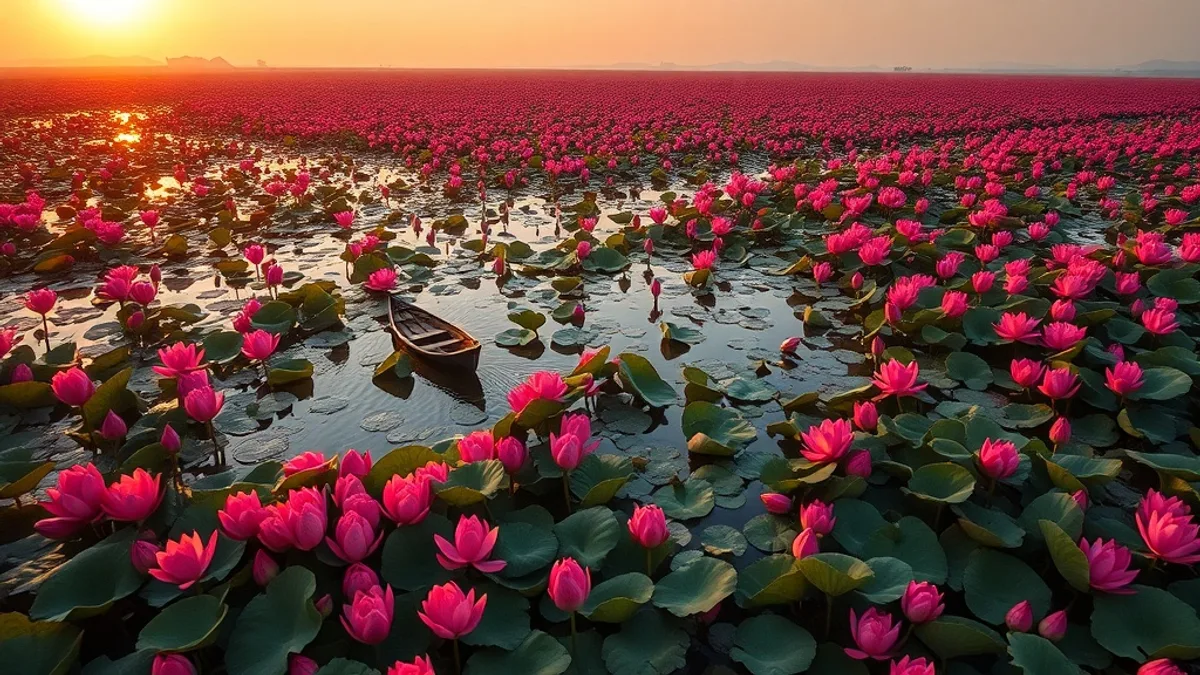
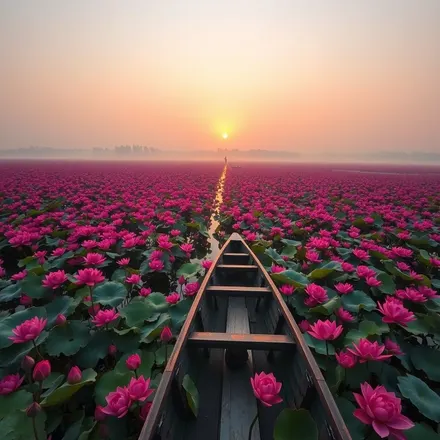
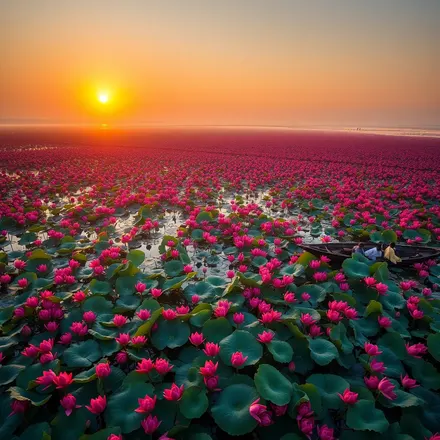
There are moments in travel when you arrive somewhere and the sight in front of you simply refuses to fit into any prior expectation. The Red Lotus Sea of Udon Thani is one of those places. Between November and February, Nong Han — the largest natural freshwater lake in Northeast Thailand — transforms into a sea of blooming red lotus flowers that stretch to the horizon in every direction. From the bow of a small longtail boat pushing slowly through the floating fields, the effect is hallucinatory: thousands of vivid crimson flowers opening to the early morning light, their reflections rippling in the still water, the sky turning gold above the treeline. This is not a manicured park attraction. This is a living natural phenomenon, worked daily by local fishing families for whom the lotus is both livelihood and landscape, and it is one of the most visually extraordinary things Thailand has to offer.
Overview
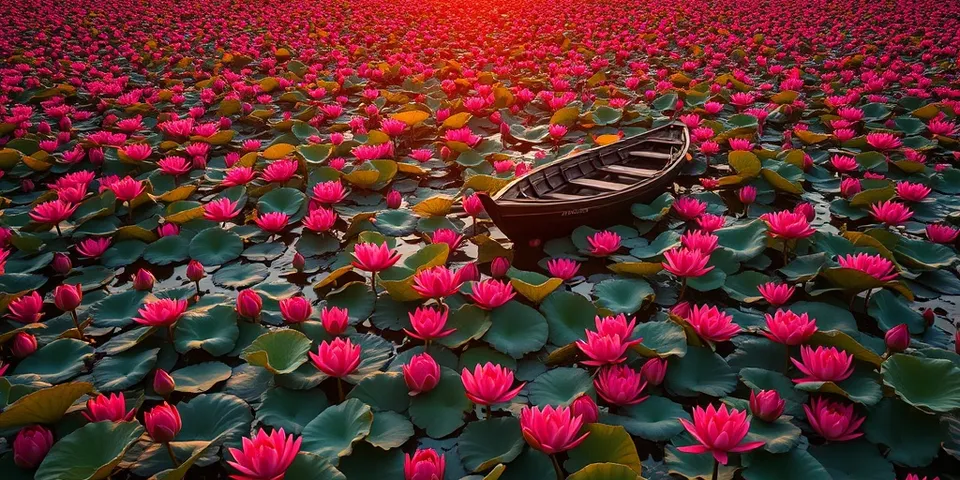
Nong Han Lake covers approximately 22,000 rai (roughly 35 square kilometres) in Kumphawapi District, about 50 kilometres east of Udon Thani city. The lake is a working body of water — home to significant populations of freshwater fish, the source of lotus flowers harvested daily by local families, and a vital wetland ecosystem for migratory and resident bird species. The red lotus (Nymphaea lotus var. rubra) blooms from November through February, with peak flowering typically occurring in December and January. The flowers open fully only in the early morning and begin closing as the sun rises higher — which is why an arrival before 7am is strongly recommended for photographers and anyone who wants to experience the spectacle at its height.
The access point is Kumphawapi pier, a small fishing community about 50 kilometres from Udon Thani city centre. Longtail boats are available for hire from the pier from around 5:30am. Shared boats carry up to 10–12 passengers and cost approximately 50 THB per person for a 60–90 minute circuit through the lotus fields. Private boat hire for groups of 2–4 costs around 300–500 THB for a two-hour excursion. The boat operators know the lake well and will navigate to the areas of densest blooming, which shifts slightly each season depending on water levels. It is worth communicating to your boat operator that you want maximum time in the lotus fields rather than a quick circuit.
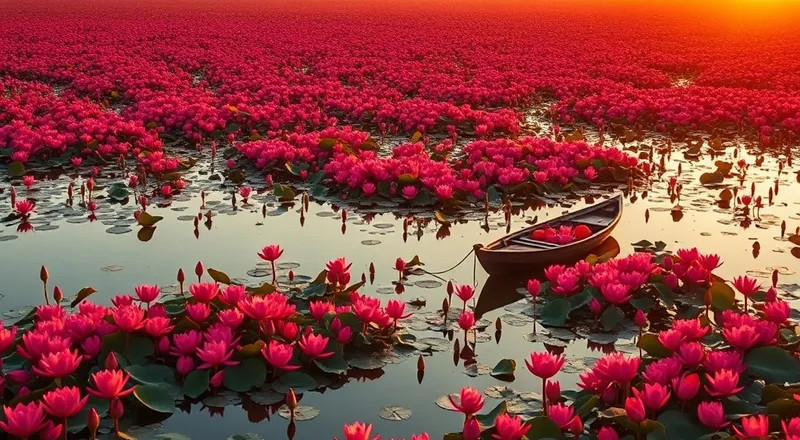
The visual qualities of the Red Lotus Sea change dramatically with the light. The golden hour immediately after sunrise (approximately 6:00–7:30am) produces the most extraordinary conditions — low-angle light illuminates the flowers from the side, the colours are saturated, and the lake surface mirrors the sky. By 9am the flowers are beginning to close, and by 10am the transformation is nearly complete. Morning mist is common in December and January and adds another layer of atmospheric drama to photography. Wide-angle shots capturing the expanse of flowers work well; telephoto shots isolating individual blooms against the light are equally rewarding.
The village of Kumphawapi has a small morning market running from 5–8am where you can buy breakfast before your boat trip — grilled sticky rice, grilled pork, hot soy milk, and traditional Isaan snacks. The market is frequented primarily by local lotus harvesters and fishermen, giving it an authenticity that tourist-facing food operations lack. Combining the Red Lotus Sea with a visit to nearby Ban Chiang UNESCO World Heritage Site (30 kilometres to the southeast) makes for a full and deeply rewarding day in Udon Thani province.
Highlights
- 22,000 rai of natural freshwater lake covered in red lotus blooms from November to February
- Peak flowering in December–January: flowers fully open only in early morning light
- Longtail boat tours from Kumphawapi pier: shared 50 THB, private 300–500 THB
- Golden hour arrival (5:30–7am) for best light and fully open flowers
- Working lake — lotus harvest by local families visible daily during season
- Morning mist in December–January adds atmospheric photography conditions
- Kumphawapi village morning market (5–8am) for authentic pre-dawn breakfast
- Bird watching: migratory and resident wetland species throughout the lake
- Easily combined with Ban Chiang UNESCO site for a full-day Udon Thani excursion
- 50 km from Udon Thani city — accessible by taxi or hired transport in 1 hour
The lotus blooms between November and February, with peak flowering in December and January. The absolute best time to visit is 5:30–7:30am, when the flowers are fully open and the light is ideal. By 9–10am the flowers close and the spectacle diminishes significantly. The lake is still beautiful outside lotus season — it is a productive wetland with good bird watching year-round — but the famous red sea effect is exclusively a November–February phenomenon. Weekends draw more visitors; a weekday morning visit guarantees a quieter experience on the water.
Practical Information
Cost Level
Longtail boat hire from Kumphawapi pier: 50 THB per person (shared boat) or 300–500 THB for a private 2-hour charter. Taxi from Udon Thani city to Kumphawapi pier: 300–400 THB each way. Rented motorcycle from Udon Thani: 250–300 THB per day, with the lake about 50km and 1 hour away. Morning market breakfast at Kumphawapi: 40–80 THB for a full local meal. There is no formal entry fee to access the pier or lake. Parking at the pier is free for motorcycles and cars.
Tips
Arrive by 6am at the latest for peak photography conditions — most visitors who have made the effort to reach Kumphawapi regret arriving too late and missing the fully open flowers. Bring a jacket even in December; early mornings on the lake are cool and mist conditions can feel damp. Hire a private boat rather than joining a shared tour if you are a serious photographer — the private operator will stop wherever you ask and spend as long as you want in the best locations. Check weather forecasts before the trip: heavy cloud cover ruins the golden light effect. Combine with the Ban Chiang visit in the same day by booking a car from Udon Thani that covers both stops.
Our creators on the ground in Udon-thani share their best recommendations in their videos.
Creators who cover this spot
Discover YouTube creators who feature this topic in their videos.

Discover Thailand
Christian
Discover Thailand – Deutscher Thailand Reise-Creator auf YouTube.

Global Travel Mate
Jeroen is a Dutch expat documenting Bangkok's urban landscape through bicycle exploration and cultural observation.

Ricky in Isaan
British expat documenting authentic daily life and culture in rural Isaan, Thailand.
Places in this Guide
Discover the attractions and locations featured in this travel guide.
Explore Udon Thani
Udon Thani
อุดรธานีUdon Thani is a vibrant Isan metropolis that blends modern city life with ancient history and natural wonders. The provi...All creators from Udon Thani →Location & Orientation


Frequently Asked Questions
When exactly does the Red Lotus Sea bloom each year?
The red lotus flowers bloom reliably from November through February each year, driven by the combination of cooling temperatures, receding water levels after the monsoon, and the natural growth cycle of the Nymphaea lotus species. Peak blooming typically falls in December and January when the density of open flowers is greatest and the visual spectacle most intense. The flowers are at their most open in the early morning hours — from just before sunrise until about 9am — as they are thermotropic and close progressively as temperatures and light levels rise. By mid-morning on a warm December day, the flowers will already be closing. Early November and late February are transitional periods when some flowers are visible but density is lower.
How do I get from Udon Thani city to Kumphawapi pier?
The most practical option is to hire a taxi or tuk-tuk from Udon Thani city to Kumphawapi pier — the journey covers around 50 kilometres and takes approximately one hour, with costs of 300–400 THB each way. Given the very early departure time required (before 6am for best conditions), arranging a pre-booked taxi through your hotel the night before is strongly recommended — few taxis are cruising for fares at 4:30am. Some hotels in Udon Thani offer dedicated Red Lotus Sea tour packages with transport included, which is the most convenient option. Renting a motorcycle and making your own way is also practical for those comfortable riding in the dark on provincial roads.
Are there lotus flowers other than red at Nong Han?
The iconic Red Lotus Sea gets all the attention, but Nong Han lake also supports populations of pink and white lotus flowers, as well as various water lily species. The red variety (Nymphaea lotus var. rubra) is visually dominant during peak season and gives the lake its name and reputation, but boat trips often pass through sections where the colour gradations shift between deep crimson, rose pink, and white. Water hyacinth and other aquatic plants also cover portions of the lake surface outside the main lotus zones. The overall botanical diversity of the lake is significant, and the density of plant life makes it a productive habitat for the waterbird species that inhabit and transit through the wetland.
Is the Red Lotus Sea a good destination for photographers?
It is one of the most rewarding photography destinations in Northeast Thailand. The combination of early morning golden light, dense red flower coverage, reflective water surface, traditional wooden longtail boats, and occasional morning mist creates conditions that produce exceptional images with minimal technical skill. A basic smartphone on a steady grip produces beautiful results. DSLR and mirrorless camera users benefit most from arriving in the pre-dawn window (5:30am) to capture the transition from mist to golden light. Drone photography of the lotus fields is visually spectacular — check current regulations with the pier operators before flying, as rules over wetland areas vary. The lotus harvesters in their traditional boats and conical hats make excellent portrait subjects if permission is obtained.
Can I visit the Red Lotus Sea as a day trip from Bangkok or Chiang Mai?
Yes, a day trip from Bangkok is feasible but demanding. The fastest connection is a morning flight from Bangkok Suvarnabhumi or Don Mueang to Udon Thani Airport, which takes approximately 1 hour and 10 minutes with multiple daily departures. From Udon Thani Airport, a taxi directly to Kumphawapi pier takes about 1 hour. The challenge is timing: the lotus flowers are at their peak between 6–9am, which makes an early morning arrival in Udon Thani essential. A very early flight or the previous evening's arrival is the practical solution. Many visitors combine the Red Lotus Sea with a night in Udon Thani, spending the evening exploring the night market, and then doing the lake at dawn the following morning before departing.