Introduction
Isaan cuisine is the great underdog of Thai food — louder, hotter, more uncompromising, and more deeply regional than anything served in a Bangkok hotel restaurant. It emerged from poverty and rice-farming culture, from a need to make simple ingredients into something extraordinary using fermentation, fire, and an unflinching relationship with chili. Today it has quietly conquered Thailand: Som Tam restaurants and Gai Yang stalls have spread to every Thai city, every food court, every market in the country, carried there by the millions of Isaan migrants who took their food culture with them. But the authentic version — eaten at its source, in the provinces of northeast Thailand, made by people for whom it is not a restaurant concept but a daily reality — remains something entirely different from any imitation elsewhere. This is what you come to Isaan to eat.
Overview
The backbone of Isaan cooking is the flavor combination that defines the region: fiercely hot fresh chilies, the sharp brightness of fresh lime, the savory depth of fish sauce and fermented pla ra, the toasty complexity of roasted rice powder, and the herbal freshness of fresh mint, culantro, and shallots. Everything else in Isaan cuisine is a variation on these elements, recombined and applied to different proteins, preparations, and occasions. Understanding this flavor logic transforms eating in Isaan from a random series of unfamiliar dishes into a coherent and deeply satisfying culinary education.
Larb is the ceremonial soul of Isaan cooking — the dish served at celebrations, merit-making events, family gatherings, and important meals. At its core it is a warm salad of minced or chopped meat (pork, duck, chicken, beef, or offal) dressed with the essential Isaan seasoning profile: lime juice, fish sauce, roasted rice powder, dried chilies, and a generous handful of fresh herbs. The roasted rice powder (khao khua) is a defining element — made by dry-roasting raw jasmine rice in a wok until golden, then grinding it coarse. It adds a nutty, toasty dimension to the dressing and absorbs the cooking juices to create a light binding texture. The 'suk' (cooked) version is more common for visitors; the 'dib' (raw or lightly cooked blood-added) version is deeply traditional and worth trying if your stomach is adventurous.
Som Tam Isaan, the authentic papaya salad of the northeast, bears only a family resemblance to the sweet, mild Bangkok version that most visitors know. The Isaan preparation uses pla ra (fermented fish paste) as the primary seasoning, often adds pu dong (raw fermented mud crab), and reaches heat levels that are genuinely challenging for anyone not raised on the food. The papaya is pounded in a clay mortar with a wooden pestle rather than a ceramic one, creating a softer texture and releasing more juice. Eating Isaan Som Tam with your eyes watering and your lips burning while locals eat theirs with apparent indifference is one of the memorable humbling experiences of Isaan travel.
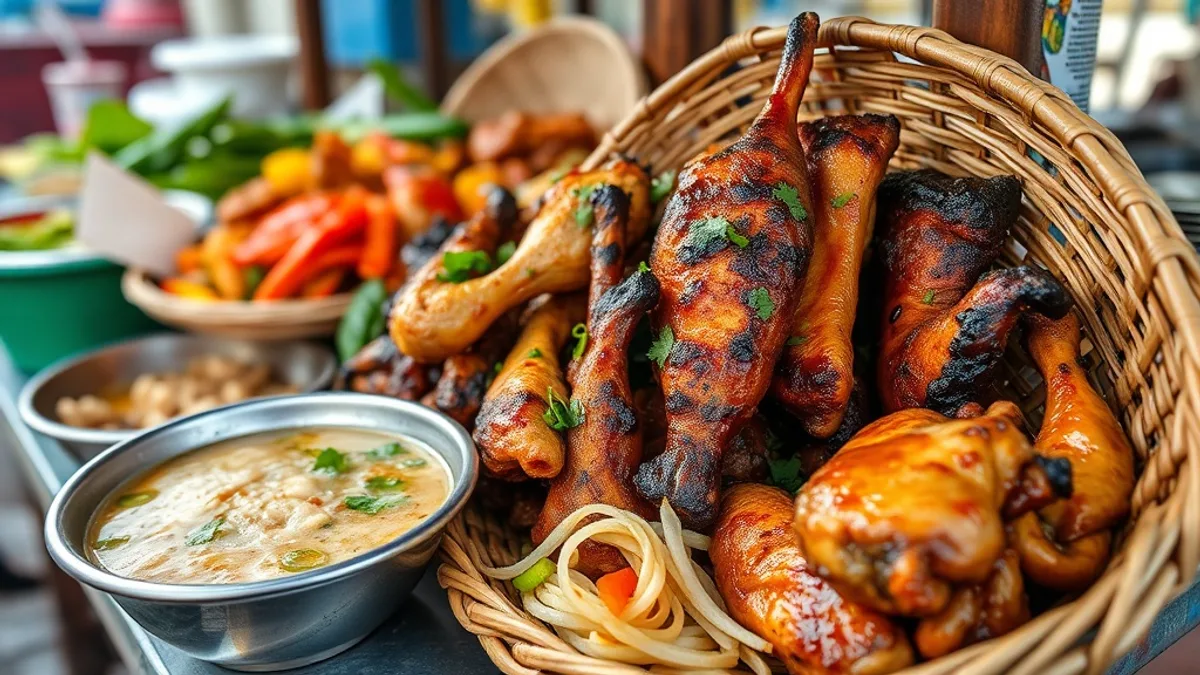
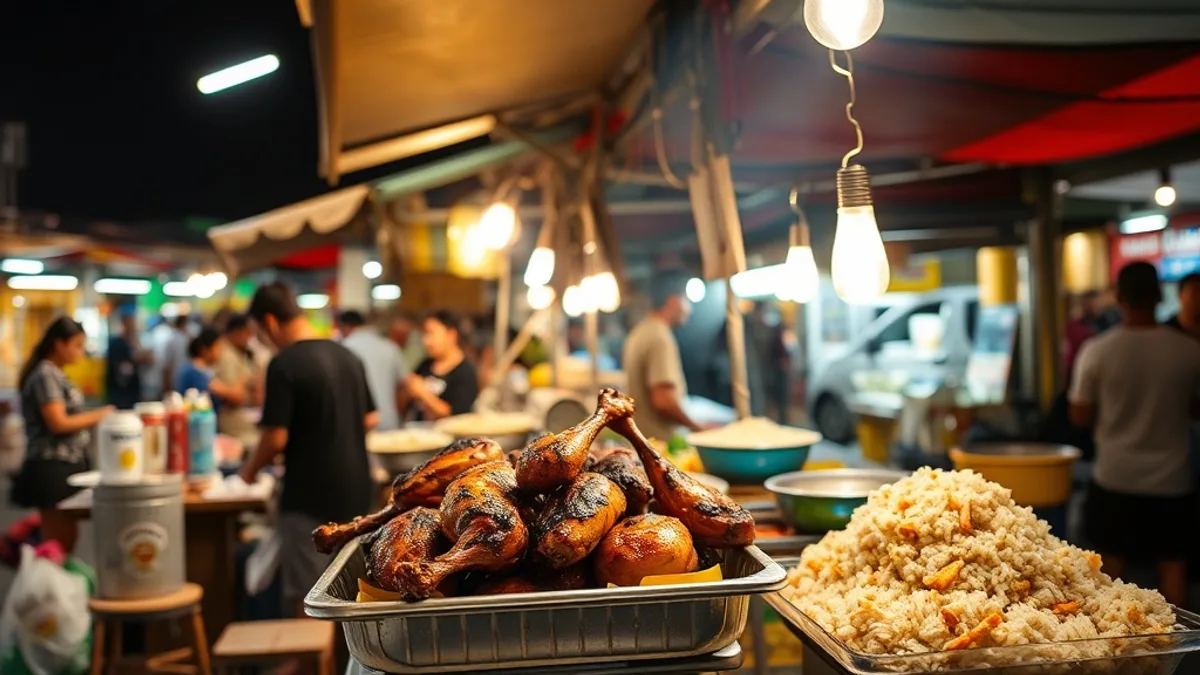
Gai Yang (chargrilled chicken) is the democratic food of Isaan — cheap, deeply satisfying, sold everywhere from pre-dawn market stalls to evening roadside grills. The preparation varies by province and vendor family, but the principle is constant: whole chickens or portions are marinated in aromatics (lemongrass, garlic, coriander root, turmeric), flattened with a cleaver, and grilled slowly over charcoal until the skin is crisp and dark, the flesh smoky and juicy. The accompaniment is always sticky rice and always some form of chili dipping sauce. The best Gai Yang vendors have queues before 7am — Isaan people eat their first proper meal very early.
Sticky rice (Khao Niao) is not a side dish in Isaan — it is the meal, with everything else serving as accompaniment and condiment. Eaten with the hands, pinched into small balls and used to scoop other dishes, it connects the meal to an agricultural culture in which glutinous rice cultivation defines the landscape, the calendar, and the social rhythm of rural life. The bamboo containers (kratip) used to serve and carry sticky rice are themselves small objects of craft — woven in traditional patterns and designed to keep the rice warm and moist for hours.

Highlights
- Larb Isaan — the ceremonial minced meat salad with roasted rice powder and fresh herbs
- Som Tam with pla ra and fermented crab — Isaan's fiercely authentic papaya salad
- Gai Yang chargrilled chicken with sticky rice at dawn roadside stalls
- Nam Tok (waterfall salad) — grilled beef slices in the Larb dressing style
- Sai Krok Isaan — sour fermented pork sausages from roadside charcoal grills
- Pla Ra — the fermented fish paste that defines the Isaan flavor profile
- Eating sticky rice with your hands from a bamboo kratip basket
- Night markets in Udon Thani, Khon Kaen, and Ubon Ratchathani — massive and vivid
- Tom Saep — the intensely sour and spicy pork rib soup of northeast Thailand
Isaan street food is available year-round, with night markets operating every evening in all major cities and most towns. The cool dry season (November to February) makes evening eating outdoors genuinely pleasant. The Ubon Ratchathani Candle Festival in July brings exceptional street food energy to that city. Isaan's major festivals (Bun Bang Fai in May, Phi Ta Khon in June/July) also generate exceptional temporary food markets around the main celebration sites.
Practical Information
Cost Level
Isaan street food is among the cheapest in Thailand. Som Tam: 40–60 THB. Larb or Nam Tok with sticky rice: 50–80 THB. Gai Yang half-chicken: 70–100 THB. Sai Krok sausages: 20–30 THB. Tom Saep soup: 60–80 THB. Iced drinks: 20–30 THB. A complete and extremely satisfying meal for two people with multiple dishes, sticky rice, and cold drinks should cost 200–350 THB. Budget travelers can eat well in Isaan for 200–250 THB per day on food alone.
Tips
Learn the key food vocabulary: 'phet mak' (very spicy), 'phet nit noi' (a little spicy), 'mai phet' (not spicy), 'aroi mak' (very delicious — your most important phrase). Isaan food is meant to be communal — ordering several dishes to share gives a much better experience than ordering a single item each. The clay mortar Som Tam vendors are usually better than those using ceramic mortars — a small detail that indicates traditional technique. Never leave Isaan without trying Tom Saep — the sour pork rib soup that most visitors overlook in favor of the more famous salads.
Our creators on the ground in Isaan share their best recommendations in their videos.
Places in this Guide
Discover the attractions and locations featured in this travel guide.
Explore Isan
Isan
อีสานIsan is the rural Northeast of Thailand, known for authentic village culture, rice farming, strong family structures and...All creators from Isan →Location & Orientation


Frequently Asked Questions
Which Isaan city has the best street food scene?
Udon Thani has the largest and most varied night market scene in Isaan, including the famous UD Town market and the Nong Prajak night market around the central lake. Khon Kaen offers excellent food in a university city atmosphere with a young, food-enthusiastic crowd. Ubon Ratchathani is often cited by food travelers as the most authentically Isaan of the major cities, with a particularly strong tradition of Larb, grilled meats, and Mekong riverside eating. For a single city visit purely for food, Udon Thani's sheer variety and scale is the obvious choice, but Ubon Ratchathani offers the most local character.
How spicy is Isaan food really?
Isaan food is genuinely among the spiciest in Southeast Asia — spicier than most Thai food served internationally, and significantly spicier than central Thai cuisine. A standard Isaan Som Tam or Larb prepared for local tastes uses quantities of dried chilies and fresh bird's-eye chilies that most non-Isaan visitors find painful rather than merely pleasurable. The key is to communicate your tolerance clearly and honestly. 'Mai phet' (not spicy) will get you a significantly milder version; 'phet nit noi' (a little spicy) still carries considerable heat. Consider building up gradually over several days rather than diving into the hottest preparations immediately.
What is pla ra and do I have to eat it?
Pla ra is a fermented freshwater fish condiment — fish cured in salt and roasted rice powder for months until it develops an intensely savory, pungent paste. It is a defining flavor of Isaan cuisine and appears in Som Tam, Larb, and many dipping sauces. You do not have to eat it — most Som Tam vendors offer a 'mai sai pla ra' (without pla ra) version using plain fish sauce instead. However, avoiding pla ra means missing a fundamental dimension of what makes Isaan food taste the way it does. The flavor is challenging initially but many visitors find it transforms from confronting to addictive fairly quickly.
Can I take a food tour in Isaan?
Organized food tours are available in the larger Isaan cities, particularly Udon Thani and Khon Kaen, where a small number of local guides offer evening market tours with tasting stops and English-language context. These are typically booked through guesthouses or local tour agencies rather than international platforms. An alternative approach — and often more rewarding — is simply following locals: if a Som Tam vendor has a queue of office workers at 11:30am, that is the place to eat. The informal food education available by pointing, ordering, and asking 'arai na?' (what is this?) is genuine and free.
What is the connection between Isaan food and Lao cuisine?
The connection is fundamental and historical — Isaan's population is majority Lao-Tai ethnic origin, with cultural ties to Laos that predate the current Thai-Lao border. Som Tam (called Tam Mak Hoong in Lao), Larb, sticky rice, Gai Yang, and most other Isaan staples are identical to or direct variations of Lao national dishes. The Isaan-Lao food culture forms a culinary region that ignores the political border of the Mekong River entirely. Visitors who cross into Laos from northeast Thailand find the food unsurprisingly familiar — an edible demonstration of how cultural geography outlasts political geography.